Today, owners of multifamily properties work in an environment where compliance, experience, and...
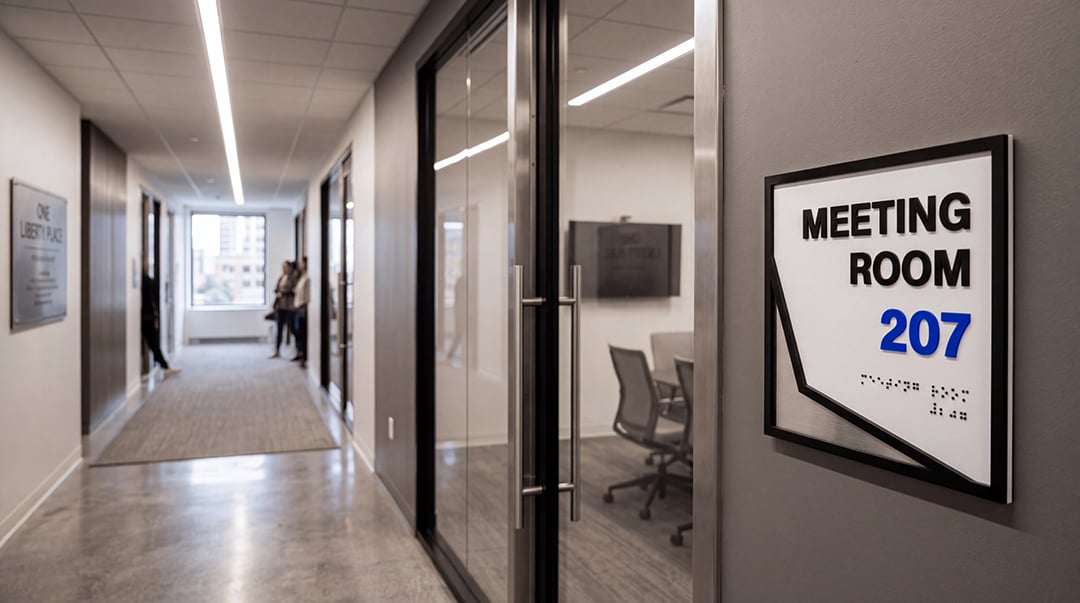
Every commercial building needs signs that people can find, read, and understand, and some of those signs must also be accessible to people who are blind or have low vision. For Philadelphia business owners, property managers, architects, and contractors, the practical question is usually whether to order custom ADA signs or go with ready-made standard options.
The answer depends on your design goals, budget, timeline, and the type of space you're outfitting. A boutique hotel in Center City has different needs than a clinic near University City or a multi-tenant office building with hundreds of doors. This guide compares both approaches, covering design, materials, compliance, and cost, so you can choose with confidence. In both cases, the sign has to meet the accessibility standards that apply to it.
What Are Custom ADA Signs?
Custom ADA signs are accessible signs designed and fabricated to a project's specific requirements. Instead of choosing from a fixed catalog, you work with a signage provider on size, layout, colors, finishes, and materials, while the sign still includes the tactile and visual features that accessibility standards require.
Common customization options for ADA signs
- Sign size and shape, including panels sized for unusual wall spaces or glass sidelites
- Colors and finishes that coordinate with interior palettes
- Materials, from acrylic and photopolymer to engraved metal and wood-look laminates
- Mounting methods, such as standoffs, adhesive mounting, or frames and holders
- Interchangeable inserts for rooms whose occupants or names change often
- Project-wide sign families where every sign type shares one visual language
Where custom ADA signs are used in commercial buildings
Custom work is common wherever signage is part of the overall design experience:
- Hotel guest room and corridor signage
- Hospital and clinic wayfinding, room identification, and restroom signs
- Corporate offices and co-working spaces
- University buildings,library signage, labs, and classrooms
- Restaurants, retail spaces, and mixed-use developments
- Apartment and condo communities (see our multifamily housing signage solutions)
Custom branding, colors, finishes, and layouts
A custom ADA sign still needs tactile (raised) characters and Grade 2 Braille for the rooms and spaces where they are required. Customization changes how the sign looks around those features, not whether they're there. A well-designed custom sign can use your brand colors, a matching finish, and a layout that complements the interior and your other interior signs, while keeping the lettering readable and the Braille correctly placed.
In Philadelphia, this flexibility matters most for office towers with a distinct tenant identity, historic buildings where the sign must suit the architecture, and hospitality or healthcare properties where the visitor experience is part of the brand.
What Are Standard ADA Signs?
Standard ADA signs, often called pre-made or off-the-shelf ADA signs, are produced in set sizes, colors, and designs. They are widely available and designed to cover the most common identification needs.
Common types of ready-made ADA signage
- Restroom signs, including men's, women's, and all-gender designs
- Room number and room name signs
- Exit and stairwell identification signs
- Conference room, office, and storage room signs
- Accessible entrance and elevator signs
Benefits of standardized sign designs
- Speed: Many items are in stock or quick to produce.
- Predictable pricing: Common designs are often less expensive per sign.
- Simplicity: There is less design work, which suits straightforward projects.
- Consistency: Matching sets are easy to reorder when you add or change rooms.
Limitations of off-the-shelf signage
- Limited choices in color, size, and style
- Little room for logos or brand-specific layouts
- A look that may clash with a carefully designed interior
- Stock options that may not fit unusual mounting locations
One point is easy to miss: ready-made does not automatically mean compliant for your use. A standard sign still needs to meet the requirements for its intended use and be installed correctly. Confirm the features and mounting before you order.
Custom ADA Signs vs. Standard Signs: Key Differences
|
Factor |
Custom ADA signs |
Standard ADA signs |
|
Design |
Tailored to the project |
Predetermined designs |
|
Branding |
More flexibility |
Usually limited |
|
Materials |
Project-specific options |
Available stock options |
|
Lead time |
May require fabrication |
Often readily available |
|
Cost |
Depends on specifications and quantity |
Often lower for common designs |
|
Compliance |
Must meet applicable standards |
Must also meet applicable standards |
Which option is best for Philadelphia businesses?
Standard signs usually make sense for utilitarian spaces: back-of-house areas, simple offices, warehouses, and small tenant improvements where speed and budget come first. Custom signs tend to be the better fit for client-facing environments, such as lobbies, guest corridors, patient areas, and branded retail spaces, where signage is visible every day.
Many properties use a mix. Custom signs go in prominent areas, and standard signs cover secondary spaces. If you take this route, make sure the finishes and typography stay close enough that the building doesn't feel inconsistent. For a Philadelphia example of signage on a new development, see our case study on signage for a new Fishtown development.
When is custom signage worth the investment?
Custom is often worth considering when:
- Brand consistency across the property matters to you
- The architecture or interior design calls for a specific look
- You have unusual sizes, mounting surfaces, or environmental conditions
- You need a large, coordinated sign family across many rooms
- Durability and finish quality are priorities for high-traffic areas
For the broader business case, see our article on the business case for environmental graphic design.
Materials Used for Custom and Standard ADA Signs
Material affects how a sign looks, how long it lasts, and how much upkeep it needs. Whatever you choose, the material and finish must preserve the required tactile features, contrast, and legibility.
Acrylic and plastic ADA signs
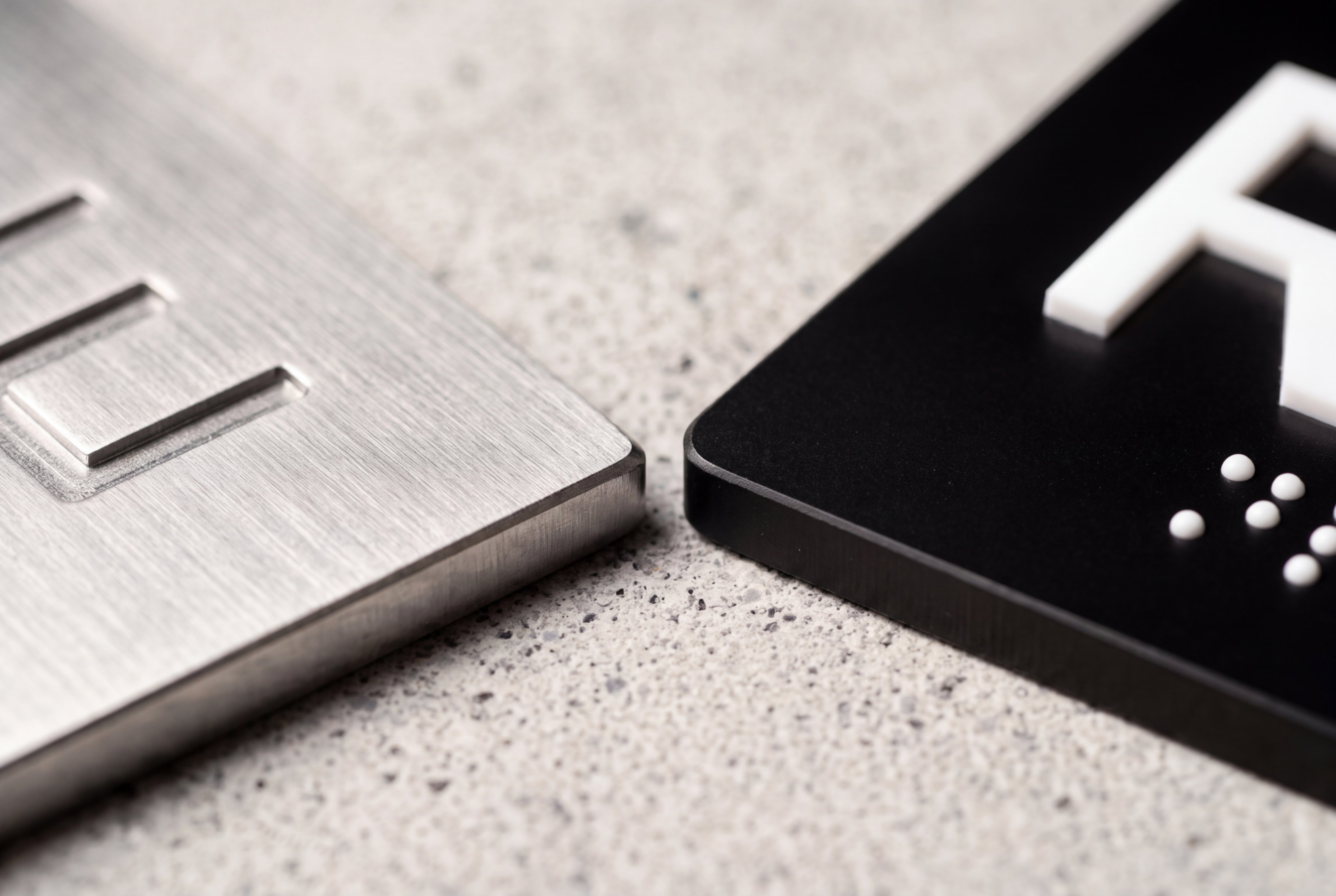
Acrylic ADA signs are among the most popular choices. They can be made in many colors and finishes, work well with clean modern interiors, and are well suited to offices, healthcare facilities, and hotels. Photopolymer and similar plastic constructions are also common, offering raised characters built up on the sign surface. Compared with metal, plastics are often more economical, but they may show wear in very harsh environments.
Metal and engraved ADA signs
ADA signs made of metal, such as brushed aluminum, brass, or stainless steel, offer a high-quality appearance and durability. They suit lobbies, historic buildings, and high-end hospitality settings. Metal signs usually cost more and take longer to fabricate, and the finish must still be non-glare so the characters are readable.
Choosing materials for durability and maintenance
Consider these factors:
- Appearance: Does the material match the interior design?
- Longevity: High-traffic corridors and exterior-adjacent locations may call for tougher materials. Our guide to how long apartment signage lasts covers maintenance and replacement timelines.
- Cleaning needs: Healthcare and food-service environments require surfaces that tolerate frequent cleaning.
- Installation environment: Humidity, sunlight, and temperature swings can affect some materials.
- Cost: Weigh upfront price against the cost of replacing worn signs.
ADA Sign Requirements: What Philadelphia Businesses Need to Know
Customization does not exempt a sign from accessibility rules. The federal baseline is the 2010 ADA Standards for Accessible Design, with sign requirements found mainly in Section 216 (where signs are required) and Section 703 (how they must be built). Requirements depend on the sign type and its location, so not every sign in your building follows identical rules.
Raised lettering and Braille requirements
“Permanent rooms and spaces (i.e., room numbers, restrooms, exits, etc.) usually require tactile characters and Braille for identification signs. The 2010 Standards mandate raised, uppercase, sans-serif tactile characters with specified height, stroke, and spacing characteristics, and Braille is Grade 2 and located below the corresponding text. Before you specify a sign, identify the function of each sign. Room identification signs are treated differently than purely directional or informational signs (such as wayfinding signs).
Contrast, character specifications, and readability
Characters and their background must contrast, typically light characters on a dark background or dark on light, and the finish must be non-glare. Character proportions, style, and size are specified in the Standards. Fancy fonts, decorative effects, and glossy surfaces can all cause a sign to fall short, which is why design flexibility has limits.
Sign placement and mounting considerations
Mounting location matters as much as the sign itself. Tactile signs are generally placed on the wall at the latch side of a door, within specified height ranges, with clear floor space so that a person can approach and read the sign by touch. Exceptions and special conditions exist, such as double doors and doors that swing into corridors, so confirm the details for each location.
Federal ADA standards and applicable Pennsylvania or Philadelphia requirements
The ADA is a federal baseline. Pennsylvania's Uniform Construction Code and the Philadelphia building code may add or reference additional accessibility provisions for new construction and alterations. For a specific project, check the 2010 ADA Standards, the building code in effect for your project, and any requirements your design team or code official identifies. When in doubt, ask your architect, code consultant, or the city's licensing and inspections office. This article is general information, not legal advice. For a property manager's view of compliance during renovations, see our guide to ADA and compliance standards in multifamily signage renovations.
How Much Do Custom ADA Signs Cost?
Prices vary too much by project to quote a trustworthy range, so it's more useful to understand what drives them. For a related breakdown, see our guide on how much wayfinding signs cost.
Factors that influence ADA sign pricing
- Sign size and complexity
- Material and finish
- Number of sign types and total quantity
- Design and proofing time
- Tactile and Braille production method
- Mounting hardware and installation scope
- Rush orders and delivery requirements
How materials, size, quantity, and customization affect cost
Typical signs in standard sizes are cheaper by the piece, especially on a simple project. Custom signs require design and fabrication work, but quantity can help: once the artwork and tooling are established, adding more of the same type of sign is often more economical on a per-sign basis. Usually premium materials such as metal will up the cost, and odd shapes or layered designs will add even more to the price.
Installation costs and project timelines
Budget for installation, which is an additional cost, especially over multiple floors or units. Timelines are different, too. Stock items can ship fast; custom projects take time for design approval, fabrication, and installation. Build in time for revisions and, if relevant, coordination with construction schedules.
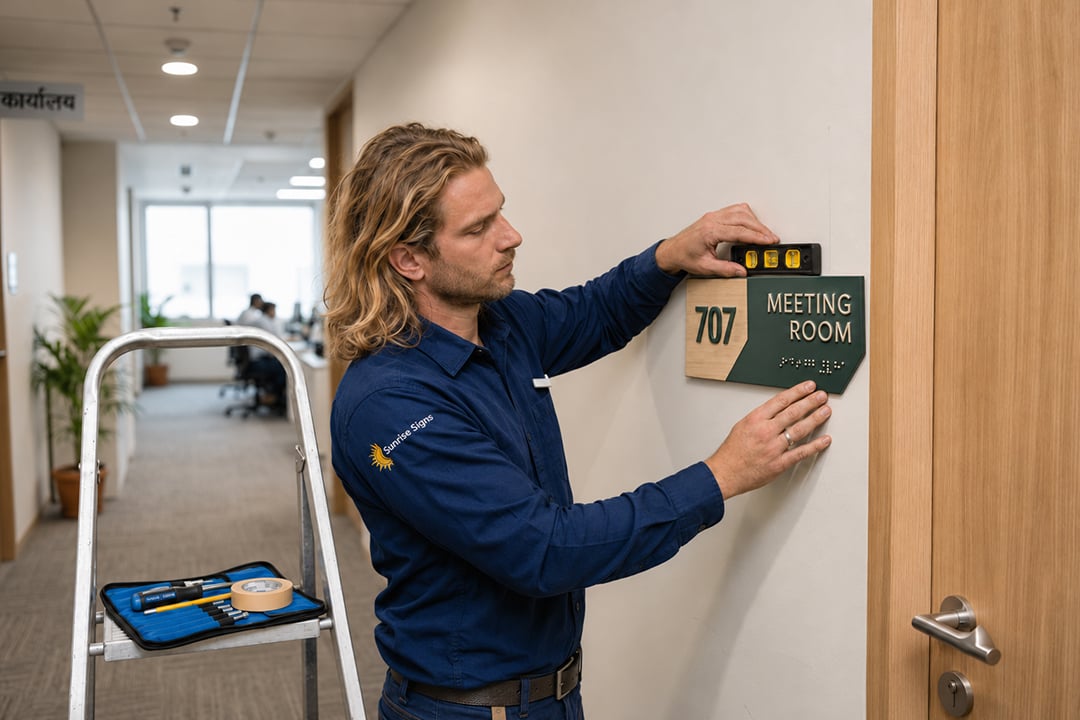
How to budget for a commercial signage project in Philadelphia
- Walk the building and make a complete sign schedule: every room, restroom, exit, and wayfinding point.
- Decide which areas deserve custom treatment and which can use standard signs.
- Request itemized quotes that separate design, fabrication, shipping, and installation.
- Ask whether the quote includes a compliance review of sign types and mounting locations.
- Add a contingency for corrections, additions, and future tenant changes.
How to Choose the Right ADA Signs for Your Philadelphia Property
Assess the building's signage and accessibility needs
Start with a sign inventory. Identify which spaces need tactile signs, which need only visual or directional signs, and which are tenant-controlled. Involve your architect or code consultant if the project involves new construction or a renovation. Thinking of signage as infrastructure, not decoration is a useful frame for this step.
Match sign materials to the environment
Choose materials for the conditions they will face: heavy cleaning in clinics, constant touch in public corridors, or sunlight near entrances. A good material choice reduces replacement costs later.
Balance branding, budget, and compliance
Decide where brand expression matters most, then make sure each design choice still meets the standards. If a design element, such as a decorative font or glossy finish, conflicts with accessibility rules, accessibility wins.
Work with a qualified signage provider
If you're weighing a national partner against a local shop, our comparison of a national signage partner vs. local sign company can help.
A good provider should be able to:
- Explain the requirements that apply to each sign type
- Show material samples and past projects
- Provide proofs before fabrication
- Offer or coordinate installation
- Give clear, itemized pricing and timelines
Quick checklist before you order:
- Complete sign schedule with room names and numbers
- Sign types identified (tactile vs. directional or informational)
- Material, finish, and color approved
- Mounting locations and heights confirmed
- Proofs reviewed, including Braille and spelling
- Installation and schedule coordinated
Conclusion: Finding the Right ADA Signage Solution
Standard signs are fast and easy for simple needs, sometimes even more economical. Custom ADA signs offer design flexibility, stronger brand alignment, and better fit for unusual or high-visibility spaces. Both must comply with the standards that apply to the specific sign, so compliance should never be the deciding factor between them. Your project requirements, budget, design goals, and timeline should be.
If you're planning a signage project, Sunrise Signs designs, fabricates, and installs ADA-compliant signs for Philadelphia properties and can review your building, recommend the right mix of custom and standard signs, and provide a quote. Schedule a consultation today to get started.