

.png)
Walk into any space that "feels right," a boutique hotel lobby, a hospital that somehow doesn't...
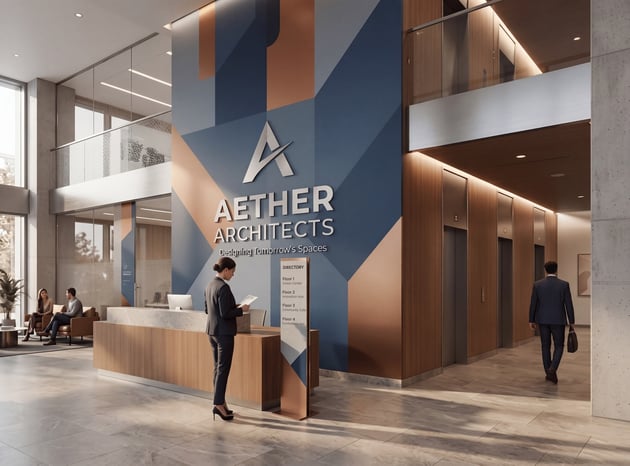
When most property owners and facility managers think about signage, they think about compliance: a lobby sign here, an ADA plaque there, and a directory board so people can find the restroom. What they often miss is that environmental graphic design, the strategic use of signage, wall graphics, wayfinding, and branded finishes throughout a physical space, is one of the highest-leverage, lowest-cost investments a property owner can make.
Environmental graphic design (EGD) is the discipline of translating a brand or a building's identity into the physical environment. It's the difference between a hallway that just gets people from A to B and one that tells them where they are, reinforces who occupies the space, and makes them want to stay longer. Done well, EGD touches everything from a corporate headquarters lobby to an apartment leasing office to a hospital corridor to a retail storefront, and in every one of those settings, it has a measurable business case behind it.
This isn't a design-taste argument. It's a revenue, retention, safety, and operating-cost argument. Here's how that case breaks down property type by property type and what the data and industry experience tell us about the return.
Why EGD Gets Deprioritized — and Why That's a Mistake
Signage and environmental graphics routinely get pushed to the bottom of a capital budget because their value is harder to isolate on a spreadsheet than, say, a new HVAC system. But that's exactly the problem: EGD's ROI shows up in metrics that ownership already tracks closely, leasing velocity, tenant retention, employee engagement scores, patient satisfaction surveys, and average transaction value; it just rarely gets attributed to the signage that influenced it.
Think of the built environment as a salesperson that operates 24/7. A building's graphics are working (or failing to work) on every single person who walks through it, whether or not anyone is paying attention. A confusing, unbranded, poorly wayfound space creates friction at every touchpoint: the new hire who can't find the right conference room, the resident who circles the parking garage looking for their building, and the patient who arrives late and stressed because directional signage stopped at the front door. Multiply that friction across thousands of visits a year, and it becomes a real cost in staff time spent giving directions, in first-impression damage, and in reduced dwell time and spending.
The businesses and property owners who treat branded workspaces and environmental graphics as a core part of their visual communication strategy, not an afterthought, consistently see the difference in harder numbers. Below is how that plays out across the property types we work with most.
Corporate Offices & Commercial Workspaces
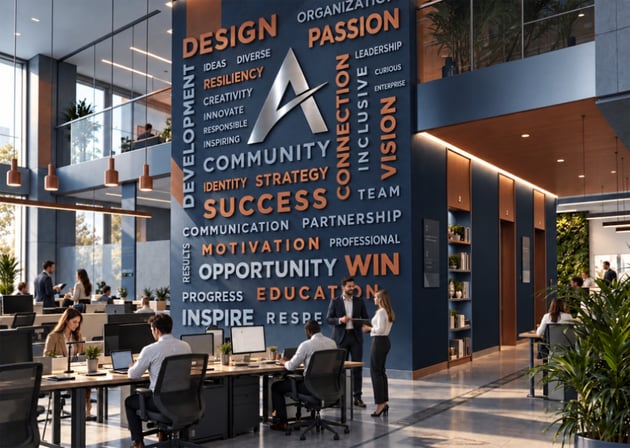
For office environments, EGD is now a recruiting and retention tool as much as a branding one. Post-pandemic, companies are competing to get employees back into physical spaces, and the space itself has to make a case for showing up.
A well-designed lobby sign does more than announce a company name; it sets the tone for every visitor, client, and candidate who walks through the door. From there, the opportunity compounds: mission statement signage and core values displays reinforce culture at a glance, corporate identity signage keeps every floor and department visually consistent, and wall graphics turn blank hallways into brand storytelling opportunities instead of wasted square footage.
There's a growing body of workplace research showing that employees report stronger emotional connection to employers whose physical space visibly reflects company values and history, which is part of why more HR and facilities teams are commissioning corporate timeline and history wall murals and asking how to actually promote core values through the built environment. The business case here is retention and culture, but it's also efficiency: clear door signage and wayfinding systems reduce the time employees and visitors spend lost or asking for directions, a small but constant drag on productivity in any multi-floor or multi-building campus.
Refreshing dated surfaces is often cheaper than most people assume. Architectural film finishes, like Di-Noc surface refurbishing, can modernize reception desks, elevator interiors, and conference room walls at a fraction of the cost of replacing the underlying furniture or millwork, a detail budget-conscious facilities directors increasingly lean on.
Multifamily & Residential Properties
In multifamily housing, environmental graphic design is directly tied to leasing velocity and resident satisfaction, two of the metrics ownership groups and property management companies watch most closely.
Prospective renters form an impression of a property within seconds of arriving, and that impression is shaped heavily by multifamily housing signage: the entrance monument, the leasing office branding, and the amenity signage around the pool or fitness center. A property that looks professionally branded reads as better-managed, which supports higher achievable rents and faster lease-up on new developments.
Beyond first impressions, EGD reduces operational headaches. Clear building signage and property-wide wayfinding cut down on the leasing office's daily volume of "where do I park" and "which building is mine" questions, a real-time cost across a large community. ADA-compliant signage isn't optional here either; it's a legal requirement for most multifamily properties, and getting it wrong exposes ownership to compliance risk and potential litigation.
Our work with developments like The Avery and a new Fishtown multifamily development shows the pattern clearly: signage that's planned early, alongside the architectural and interior design process, does more work per dollar than signage bolted on after construction wraps.
Healthcare Facilities
Healthcare may be the property type where the business case for environmental graphic design is easiest to quantify, because wayfinding failures in hospitals and medical campuses have a direct, well-studied cost.
Patients and families who get lost in a hospital arrive late to appointments, experience elevated stress before clinical encounters, and consume staff time that could otherwise go toward patient care. Hospital administrators increasingly treat wayfinding system design for hospitals and healthcare facilities as a patient-experience and operational-efficiency initiative, not a cosmetic one, because it measurably is. Clear signage reduces missed appointments, eases the burden on front-desk and security staff who would otherwise field constant direction requests, and contributes directly to the patient satisfaction scores that increasingly tie to reimbursement in value-based care models.
ADA compliance carries extra weight in healthcare as well, given the population being served; accessible, legible, and code-compliant signage isn't a nice-to-have in this environment.
Hospitality, Retail & Commercial Properties
In hospitality and retail, environmental graphics function closer to a marketing channel than a facilities item. Every wall, window, and wayfinding element is an opportunity to reinforce brand and influence buying behavior in real time.
Retail and commercial tenants that invest in cohesive environmental branding, interior wall graphics, window graphics, graphics, and consistent signage across multiple locations see the return show up in dwell time and brand recall, the same metrics that justify traditional advertising spend, except the "ad" here runs continuously with no media buy. For multi-location commercial brands, cohesive environmental branding is also where consistency across properties becomes a competitive advantage: a customer who recognizes and trusts the look of one location extends that trust to every other location carrying the same visual system.
Industrial, Distribution & Home Services Facilities
Industrial and distribution facilities are sometimes the last property type to get an environmental graphics upgrade, but the business case there is arguably the most straightforward: safety and efficiency. Clear directional and safety signage in a warehouse or distribution center reduces incident rates and speeds up onboarding for new staff who need to learn a facility's layout quickly.
There's also a branding dimension that's easy to underestimate in industrial and home services businesses, where the facility itself and the vehicles associated with it often serve as the primary brand touchpoint for prospective commercial clients who visit for a walkthrough or site visit before signing a contract. The same logic that applies to commercial vehicle wraps and industrial fleet branding as moving advertisements applies equally to the facility a fleet operates out of.
The Common Threads Across Every Property Type
Regardless of the property type, three benefits of environmental graphic design show up consistently:
- Reduced friction and operating expenses. Every minute a visitor, employee, resident, or patient spends confused or lost is a cost in staff time, in safety risk, and in a diminished first impression. Strong wayfinding and signage systems are one of the most cost-effective ways to eliminate that friction at scale.
- Stronger brand equity and retention. Whether it's an employee deciding whether to stay, a resident deciding whether to renew a lease, or a customer deciding whether to return, a physical environment that visibly reflects a coherent brand builds trust faster than an unbranded one.
- Compliance and risk reduction. ADA-compliant signage isn't optional in most commercial, multifamily, and healthcare settings, and getting it wrong creates real legal and financial exposure. Building it into the environmental graphics plan from the start is far cheaper than retrofitting after a complaint.
How to Approach EGD as a Capital Investment, Not a Line Item
The property owners who get the strongest return from environmental graphic design tend to do a few things differently. They plan signage and wayfinding alongside architecture and interior design rather than after the fact, which is especially critical on large-scale, design-build signage projects where sequencing and permitting can make or break a timeline. They also think carefully about who they hire to execute the vision, weighing the trade-offs between a national signage partner and a local sign company rather than defaulting to whichever vendor is easiest to find.
Budget matters too, but it shouldn't be the only lens. A price match guarantee and a design satisfaction guarantee reduce the risk of committing capital to a signage program that misses the mark, which is often what keeps EGD stuck at the bottom of the priority list in the first place.
Making the Case Internally
If you're a facilities director, property manager, or marketing lead trying to build the internal case for an environmental graphics investment, anchor the pitch in metrics your leadership already tracks: leasing velocity and renewal rates for multifamily, patient satisfaction and staff time for healthcare, employee engagement and recruiting metrics for corporate offices, dwell time and conversion for retail. EGD isn't a separate line item competing against those goals; it's one of the more direct levers available for moving them.
Why Property Owners Work With Sunrise Signs
Sunrise Signs has been designing and installing environmental graphics for businesses, developers, and property owners since 2008, backed by a nationwide network of 400+ installers so multi-site portfolios can roll out a consistent look on a consistent timeline. Every project moves through the same structured process of discovery, planning, design, and installation with art proofs and project updates along the way, so ownership groups and facilities teams aren't left guessing about progress on large or phased rollouts. That process, paired with the price match and design satisfaction guarantees mentioned above, is what turns environmental graphic design from a one-off vendor purchase into a repeatable capital programme.
Ready to See What This Looks Like on Your Property?
Every property type has a different starting point, but the process is the same: understand the space, understand the brand, and design an environmental graphics system that does real work for both. Browse examples across interior signs, outdoor signs, and full project case studies to see how this plays out in practice, or request a quote to talk through what environmental graphic design could do for your property.

