If you've started shopping for new signage, you've probably noticed there are two very different...

If your business operates in more than one city, whether that's three retail locations, a regional restaurant chain, a portfolio of apartment communities, or a fleet of service vehicles spread across several states, signage is rarely as simple as "just order another sign." Every new location brings a new set of local vendors, new lead times, new price quotes, and new opportunities for your brand to look slightly different from one address to the next.
That's the exact problem a national signage partner is built to solve. Instead of juggling a different sign shop in every city, multi-location businesses are increasingly consolidating their branding, wayfinding, fleet branding, and interior signage under a single partner who understands the brand once and can execute it everywhere. Below, we'll walk through why this shift matters, what it actually saves you, and what to look for when you're ready to make the switch.
What Is a National Signage Partner?
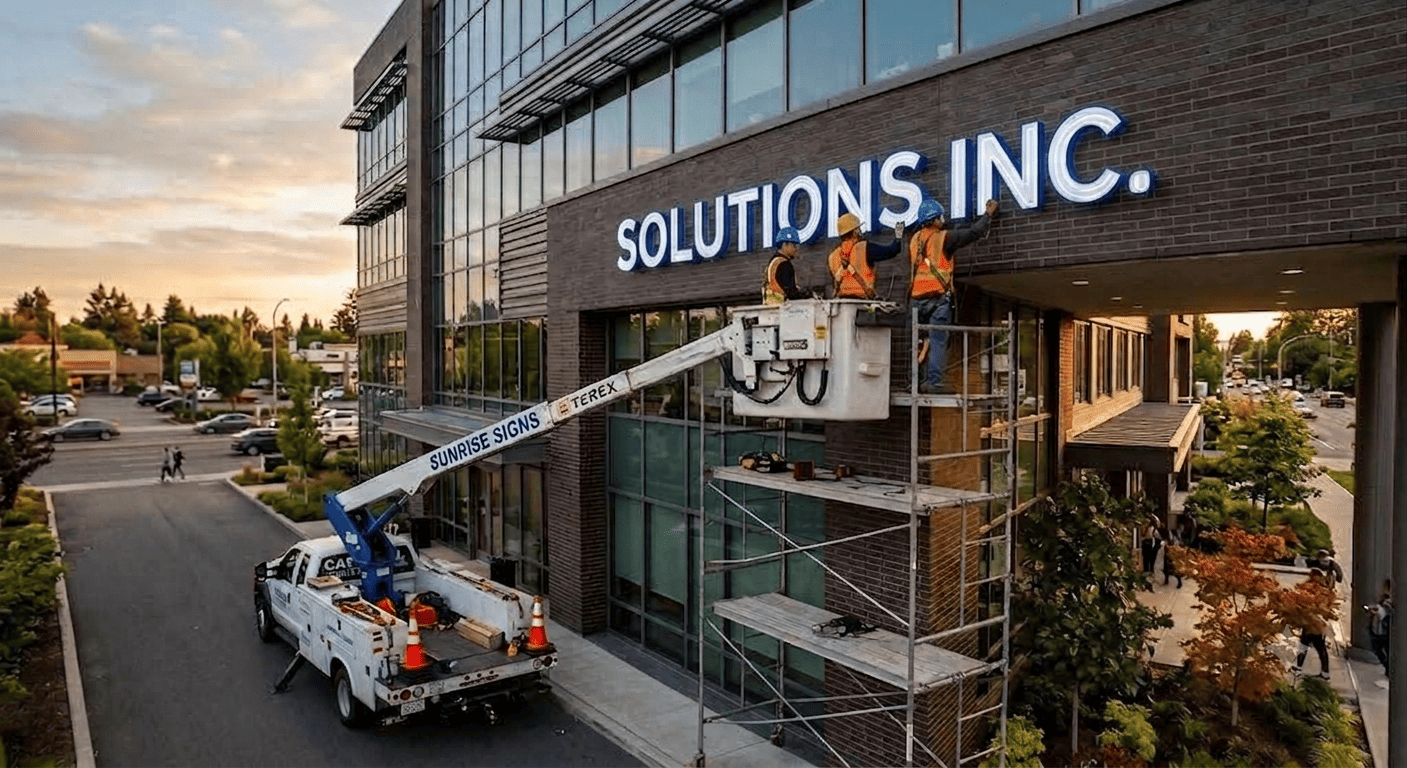
A national signage partner is a single sign company like Sunrise Signs, established in 2008 and backed by a network of 400+ installers across the country that manages design, production, and installation for a business across all its locations, rather than requiring the business to source a new vendor city by city.
This model has become especially common among franchises, multifamily housing developers, healthcare systems, hospitality groups, and companies with large deliveries.
1. Brand Consistency Across Every Location
The most obvious and most valuable benefit of a national signage partner is consistency. When one company owns your brand standards (exact Pantone colors, approved fonts, logo spacing, material specifications), every location gets signage that matches, down to the finish on your channel letter signs or the vinyl on your monument signs.
Brand consistency isn't just an aesthetic preference; it's a trust signal. Consumers shopping multiple locations of the same brand expect a consistent experience, and inconsistent signage (slightly different logo colors, mismatched fonts, or dated designs at older locations) quietly erodes that trust. One signage partner is the keeper of your brand guidelines, so no single location, franchisee, or regional manager is likely to inadvertently go off-track.
2. One Point of Contact Instead of Dozens of Vendors
Ask any operations or facilities director who has managed signage across 10+ locations, and they'll tell you the biggest hidden cost isn't the signs themselves; it's the coordination. Sourcing quotes from local vendors in every market, tracking down proofs, chasing installation schedules, and fielding calls about a cracked panel in one city while a new location in another city is behind schedule is a full-time job in itself.
A national partner consolidates all of that into a single relationship. One team handles discovery, planning, design, project management, and installation for every site, which means your team makes one phone call instead of ten. This is particularly valuable for multifamily housing operators, who often need to coordinate wayfinding signs, building signs, and ADA signage across an entire portfolio of properties on staggered timelines.
3. Volume Pricing and Predictable Costs
Sign shops price differently for a single custom order versus a repeatable program. When a national partner knows they're producing the same lobby sign package, the same fleet vehicle wraps, or the same wayfinding system across 15, 50, or 200 locations, they can standardize materials, templatize production, and pass volume efficiencies back to you.
That translates into two things multi-location businesses care about most: lower per-unit costs and predictable budgeting. Instead of every regional manager negotiating their own price with a local vendor (and inevitably paying different rates for the same sign), a national contract locks in consistent pricing across the entire footprint, making it far easier to forecast signage spend for next year's expansion plan.
4. Faster, More Scalable Rollouts
Growth-stage businesses opening new franchise territories, a multifamily developer opening a new phase of a property, or a service company adding trucks to its fleet can't afford to wait weeks for a new vendor to get up to speed on their brand every time they enter a new market. A national signage partner already has your design files, material specs, and installation standards on record, so a new location rollout becomes a matter of scheduling, not reinventing the process.
This matters most in situations like phased multifamily construction, where signage needs shift as a property moves from construction to leasing to full occupancy. A partner who already understands your brand and property type can move faster than a new vendor learning your standards from scratch and can help you avoid the common pitfalls that make multifamily signage more complicated than it looks.
5. Consistent Navigation of Local Codes and Compliance
Every city, county, and state has different sign ordinances, permitting requirements, and ADA compliance standards. A local sign shop in one market may know their own jurisdiction well but have no experience with the rules two states over. A national partner, by contrast, builds institutional knowledge of code requirements across many markets and has already solved the compliance puzzle for similar properties before.
This is especially important for ADA-compliant signage, which has strict, non-negotiable federal specifications for tactile lettering, Braille placement, and mounting height, layered on top of state and local variations. Getting it wrong means re-fabrication, fines, or delayed occupancy, costs a national partner is positioned to help you avoid because they've already navigated it in dozens of other markets.
6. Uniform Quality Control and Installation Standards
Sign quality varies enormously between vendors; material grade, print resolution, lamination process, and installation technique all affect how long a sign holds up. When every location sources from a different shop, quality becomes a gamble. One store might get vibrant, durable graphics; another might get a sign that fades within a year.
A national partner applies the same quality standards, the same premium materials (Sunrise Signs, for example, sources from major suppliers like 3M), and the same installation training across every job, so a sign installed in one city holds up exactly as well as the same sign installed 1,000 miles away. That consistency protects your brand's appearance for years, not just on installation day.
7. Simplified Ongoing Maintenance and Refresh Programs
Signage isn't a one-time purchase; it needs periodic maintenance, repairs, and refreshes as your brand evolves or as wear and tear accumulates. Coordinating repairs across a multi-location footprint through local, one-off vendors means re-explaining your brand standards every single time something breaks.
A national partner can instead set up an ongoing maintenance relationship: one team that already has your specs on file, ready to repair a damaged panel, replace faded vehicle graphics, or refresh interior branding as part of a scheduled programme rather than a scramble. This is particularly valuable for fleet-heavy businesses, where damage from weather, road debris, or accidents is a matter of when, not if and where partial wrap strategies can extend the life of a wrap and reduce refresh costs across a large vehicle fleet.
8. Fleet and Wayfinding Consistency at Scale
For businesses with vehicles on the road, home services companies, distributors, restoration companies, and delivery fleets consistent vehicle wraps act as rolling billboards. A patchwork of wrap styles across regional fleets dilutes that advertising value. Studies on fleet vehicle wrap advertising consistently point to strong impression counts and brand recall but only when the design is consistent enough to be instantly recognizable.
The same logic applies to wayfinding. Multi-site healthcare systems, campuses, and property portfolios rely on wayfinding signage to reduce confusion and improve the visitor experience; a partner who has already solved wayfinding for healthcare facilities at one site can apply the same proven system efficiently at the next.
9. Stronger Design Standards That Actually Support Marketing Goals
Beyond production logistics, a national signage partner functions as a design partner too, helping ensure that new locations don't just match old ones but that every sign, wrap, and interior graphic is engineered to support lead generation and brand recall, not just look "nice." This is especially visible in vehicle branding, where thoughtful wrap design is often the difference between a wrap that generates calls and one that simply blends into traffic.

What to Look for in a National Signage Partner
Not every "national" signage company delivers on the promise. Before consolidating your signage program under one vendor, look for:
- A real installer network, not just a design office, Production quality means little if local installation is inconsistent.
- A documented brand standards process so every new location starts from the same design file.
- Experience in your specific vertical (multifamily, healthcare, franchise retail, fleet-heavy service businesses) since code requirements and use cases differ significantly.
- A single project management team who can speak to rollout timelines across every market you operate in.
- Guarantees on design and pricing, such as a design satisfaction guarantee or a price match guarantee, which signal a company confident in both its creative work and its cost structure.
Why Multi-Location Businesses Choose Sunrise Signs
Since 2008, Sunrise Signs has grown from a Philadelphia and Tri-State area sign company into a nationwide signage partner, supporting customers across the country through a network of 400+ installers. That combination of a design and project management team that knows your brand intimately, paired with the reach to install consistently in any market, is exactly what multi-location businesses need as they scale.
Whether you're managing branded workspaces across a growing corporate footprint, rolling out signage for a new phase of multifamily housing, or standardising a fleet of vehicles across every territory you serve, a single accountable partner removes the guesswork, protects your brand, and gets new locations open faster.
Conclusion
Managing signage across multiple locations doesn't have to mean managing multiple vendors, multiple price sheets, and multiple versions of your brand. The businesses that scale most smoothly, including franchises, multifamily portfolios, healthcare systems, and fleet-heavy service companies alike, are the ones that treat signage as a single, coordinated program rather than a location-by-location afterthought. A national signage partner brings brand consistency, predictable pricing, faster rollouts, and compliance expertise together under one accountable team so every new location opens looking and functioning exactly the way it should.
If your business is growing past the point where local vendors can keep up, consolidating under one national partner is one of the simplest operational changes you can make and one of the ones customers notice most.
Ready to Consolidate Your Signage Program?
If you're tired of managing a different sign vendor in every market, it's worth a conversation.
Contact our Team